1-Decanethiol: Comprehensive Insight
Historical Development
Decanethiols—straight-chain alkane thiols—first appeared in laboratory notes back in the golden age of organic synthesis at the end of the 19th century. Chemists at the time explored sulfur-containing organics, trying to unlock new smells, catalysts, and chemical behaviors. The specific compound 1-decanethiol, with its streaky sulfur aroma, sparked early industrial curiosity due to its strong reactivity and potential in specialty manufacturing. Through the decades, the precise methods used to make straight-chain thiols matured, and 1-decanethiol entered catalogs for research and industrial use by the mid-20th century. The demand for specialty mercaptans drove the petroleum and fine chemicals industries to optimize and scale up production, bringing tighter control over purity and consistency.
Product Overview
1-Decanethiol stands out as a colorless to pale yellow liquid with a sharp, pungent smell—a classic trait of thiols. Its molecular formula, C10H22S, sits at the boundary between simple alkanethiols and more complex, functionalized organics. Users often seek it for its surface-active attributes, making it useful in fabricating advanced materials, modifying metal surfaces, tuning the wettability of certain coatings, and even producing specialty flavors in the lab. Modified thiol chemistry with decanethiol also allows researchers to create self-assembled monolayers (SAMs), which anchor onto gold, paving the way for sensor applications and nanoscale device research.
Physical & Chemical Properties
A closer look at its physical form reveals a boiling point hovering around 225°C and a melting point falling between -20°C and -21°C. Its density clocks in at roughly 0.845 g/mL at 20°C, so it sits at the lighter end among the heavier chain thiols. The liquid form’s stubborn odor—stronger than most industrial chemicals—serves as a stark warning to always manage ventilation properly. From a reactivity angle, the thiol functional group (–SH) remains both a strength and a weakness: it binds easily to metals, yet can oxidize to form disulfides if left unchecked. Its flash point, about 92°C, means lab and production teams need to treat it with the same respect as other volatile organosulfur compounds. Water solubility stays extremely low, which fits with most mid-chain alkane thiols.
Technical Specifications & Labeling
Reputable chemical suppliers dish out 1-decanethiol at purities topping 98%, sometimes going higher for electronics or research demands. Batch labels list exact content, water levels, and, for the most stringent uses, trace metal analysis. Common identifiers include the CAS Number 143-10-2 and EC Number 205-582-1. Any safety data sheet draws attention to the UN number 3332 under the “Toxic liquid, organic, n.o.s.” DOT classification. Specification sheets drill down to refractive index—usually about 1.447 at 20°C—and detail required storage conditions, like keeping it cool, away from oxidizers, in tightly sealed containers. The distinctive sulfur smell cues even laypeople that they're working with a compound needing care.
Preparation Method
Producers traditionally craft 1-decanethiol by reacting 1-decene with hydrogen sulfide, using an acidic catalyst to push the reaction along. The process happens in a high-pressure environment, with temperatures dialed high enough to crack open the double bond and let the sulfur in. Cleaning up afterward means stripping out side products, neutralizing acids, and running distillation to wring out high-purity thiol. Smaller labs often reach for halide substitution, swapping out a bromine or chlorine on decyl halide with a sodium hydrosulfide solution, but those yields rarely match the scale of a petroleum refinery’s reactor train. Over time, process engineers swapped older batch techniques for continuous-flow systems, which boosted both yield and safety by keeping everything steady and sealed.
Chemical Reactions & Modifications
The –SH group on 1-decanethiol brings a lot of chemistry to the table. In gold-thiol self-assembled monolayer formation, gold surfaces pull in the thiol group, locking the rest of the carbon tail into place. This lays the groundwork for sensor chips, organic electronics, and even medical diagnostics. Heat or oxidizing agents push couples of 1-decanethiol molecules into forming decyl disulfide, a reaction worth tracking in both storage and synthetic planning. Its sulfur atom anchors onto transition metals, useful for modifying catalyst surfaces or tuning nanoparticle interfaces. In organic syntheses, the thiol group can substitute for halogens, participate in Michael additions, or get protected and removed as groups shuffle around more complex scaffolds. Careful titration lets chemists control chain length and functional group placement—key for nanotechnology or building molecular switches.
Synonyms & Product Names
Over the years, 1-decanethiol has picked up a fair share of aliases in the trade. It shows up under "n-decyl mercaptan", "decane-1-thiol", "decanethiol", and in a pinch, just “decyl thiol”. Certain catalogues tag it with purity grades or hints about manufacturing origin, but the chemical always circles back to its ten-carbon skeleton with a terminal –SH group. Some suppliers tack on trade names, especially for bulk quantities sent into polymer or lubricant production pipelines.
Safety & Operational Standards
Staff handling 1-decanethiol need to understand industrial hygiene. Even a small spill in a poorly ventilated room fills the air with an unmissable, noxious stench. Prolonged exposure leaves skin irritated and eyes watering. Lab and plant workers don gloves, goggles, and splash-resistant coats, keeping containers closed unless drawing a sample. Emergency protocols rely on eye wash stations and showers. Storage stays away from oxidizers or strong acids, never placed near ignition sources because vapors can ignite under the right conditions. Workers track every shipment, logging batches to keep tabs on inventory and incident potential. It pays to keep air monitoring sensors on in the area, since sulfur volatiles spread fast, and even a minor leak lingers for weeks in storage spaces. Spill kits and neutralizing solutions stand ready, showing lessons learned from decades of hands-on chemical operations.
Application Area
1-Decanethiol carves out a niche both in the lab and on plant floors. Surface chemists lean on it to make well-organized self-assembled monolayers when wiring up nanoscale circuits or etching biosensor arrays. Its chain length and hydrophobic tail let it tune the wettability or conductivity of surfaces, important for electronics and anti-fouling coatings. Polymer chemists blend it in as a chain transfer agent, adjusting molecular weight in specialty rubbers or plastics. In the oil and lubricant industry, 1-decanethiol pops up in additives that fight wear and corrosion, exploiting the strong sulfur-metal bonds. Occasionally, controlled dilutions turn up in specialty flavors or fragrances, though only after safety screens. Over the years, industrial users discovered unique ways to anchor catalysts, fabricate microchips, and create smart materials just by tweaking how and where they use this versatile thiol.
Research & Development
Far from a one-trick pony, 1-decanethiol keeps researchers interested. Work at national labs and private companies hunts for new ways to functionalize surfaces with nanometer precision. Materials science experiments build custom sensor platforms by layering these thiols onto gold, then using the terminal alkyl chain to interface with proteins, DNA, or charge-sensing molecules. Innovations in green chemistry push for cleaner synthesis routes, replacing harsh reagents with lower-impact alternatives. Teams working on organic electronics see promise in tailoring the length of thiol-modified chains to control charge transfer and performance in thin films. Each improvement in surface chemistry or functionalization technology draws attention back to controlling every aspect of the thiol’s purity and reactivity.
Toxicity Research
Studies of 1-decanethiol toxicity chart both acute and chronic effects. Researchers testing occupational risk point out low but significant irritation on skin and eyes, especially in settings with vapor exposure above recommended limits. Rodent studies echo the need for caution, as direct exposure to high doses over extended periods can hit liver and kidney function. Regulators set time-weighted averages for permissible workplace exposure at just a few ppm, flagging both short-term discomforts and long-term organ impacts. Environmental scientists track breakdown rates and persistence, given the low water solubility and potential for bioaccumulation in some settings. Real-world incident data shows quick medical treatment limits the worst outcomes, but best practices mean ventilation, fast spill response, and robust PPE make more sense than trying to rely on medical fixes after the fact.
Future Prospects
The push toward advanced electronics, improved catalyst supports, and greener synthetic pathways pushes demand for specialty thiols like 1-decanethiol upwards. Teams are looking at automating monolayer formation on new materials, raising the bar for both purity and consistency. As organosulfur chemistry moves deeper into energy, electronics, and biomedicine, downstream users will put more pressure on suppliers to deliver reproducible, ultra-clean product. There’s also a growing desire for bio-based or recyclable synthetic routes, possibly starting from plant-derived decene or upgrading fermentation-derived intermediates. Researchers eye new applications in diagnostics, nanomedicine, and responsive materials, betting that controlled thiol chemistry can solve problems at the intersection of biology, electronics, and smart surfaces. The journey of 1-decanethiol mirrors the pace of science itself, responding to each new challenge with fresh thinking about structure, safety, and transformative potential.
Breaking Down What 1-Decanethiol Does
Step into an industrial supply room or a university chemistry lab and you might spot a bottle labeled 1-Decanethiol. Not exactly a household word, but this chemical pops up in more places than most folks realize. What uses deserve some attention? Here’s a look at the way 1-Decanethiol quietly fuels both industry and research, why it matters, plus some challenges and steps forward.
Behind the Bottle: Where 1-Decanethiol Shows Up
Folks in rubber manufacturing will recognize 1-Decanethiol as a handy additive. In this world, tire tread, belts, and hoses need careful tweaking to hit the right balance between toughness and flexibility. During my own time working part-time at a plant that churned out molded rubber, our polymer engineers explained that organosulfur compounds like decanethiol help kick-start vulcanization. Vulcanization might sound like sci-fi, but it’s just the process that keeps rubber from crumbling or getting sticky in summer heat. It’s easy to overlook, but transportation, construction, and even some medical devices lean on processes that count on this sulfur-boosted reaction.
Beyond rubber, 1-Decanethiol lends its strong odor to specialty fragrances, helping creators build up certain scents. Flavors and fragrances form an industry built on tiny tweaks, and a powerful, natural-smelling thiol lets the pros craft products ranging from cleaning formula fragrances to gourmet food aromas.
In research labs, 1-Decanethiol finds work as a surface modifier. My university chemistry department loved pulling this chemical off the shelf. When building so-called “self-assembled monolayers,” decanethiol lets researchers create tiny films, just one molecule thick, that help sensors detect changes or keep corrosion away from metal. New electronics, biosensors, and nanotechnology research ride on this sort of chemical fine-tuning.
Why 1-Decanethiol’s Role Matters
The knock-on effects of using the right additives in rubber can’t be overstated. Good tires grip the road, last longer, and keep people safe, all thanks in part to the chemistry put together in design and production. New tech like biosensors and anti-corrosion coatings also reach practical use because chemicals like 1-Decanethiol give engineers control over how surfaces interact with water, air, or even the human body.
This chemical shows up in a “dirty jobs” way in refiners and fuel companies, too. Processing crude oil into gasoline or diesel sometimes produces sulfur compounds. Blenders use decanethiol or close chemical relatives to help remove impurities, boost safety, or adjust characteristics so that fuels burn more cleanly. It's not glamorous, but these invisible choices steer both environmental and safety outcomes.
Challenges and Moving Forward
Folks working with 1-Decanethiol have to respect its strong smell and potential hazards. I’ve seen safety crews triple-check ventilation and mask fit when prepping thiols for the lab. Regulators rightly keep an eye on chemical emissions, and tighter rules in the future could shape how manufacturers work with 1-Decanethiol.
Solutions—like better fume handling, new closed-system production, and improved substitutes—get a boost from real-world research. Overhauling chemical steps can take patience and money, but every step toward lowering emissions or improving waste management pays back in healthier working conditions and less environmental impact.
1-Decanethiol might not earn headlines, but it sticks with daily life in more ways than most people see. As industries push for safer, cleaner processes, chemicals like this deserve closer, thoughtful attention from both engineers and regulators.
Why 1-Decanethiol Calls for Caution
Anyone who’s opened a bottle of 1-Decanethiol knows it doesn’t mess around. That strong, sulfur-like smell punches you in the face and lets you know what you’re dealing with. The compound helps in making flavors, fragrances, even fungicides, but the risks stick, no matter the final use. Breathing in its fumes, touching it, or spilling it on your clothes can irritate skin, eyes, and lungs pretty quickly. This isn’t some mild household chemical you splash without worry.
What Experience Teaches About Handling
From working with foul-smelling lab chemicals, I learned that rushing costs you, so slow down and suit up. I remember thinking one quick pipette transfer wouldn’t need gloves or extra gear. Big mistake. Stubborn odors clung to my hands for days, and that was mild compared to what could have happened if it splashed in my face.
Gloves make a real difference. Nitrile or butyl rubber holds up where latex fails. I still remember skin feeling itchy after skipping proper gloves. Chemical splash goggles aren’t decorative; this stuff has a way of finding its way into your eyes, even if you’re careful. A simple bump could send droplets flying.
Ventilation often gets ignored, especially outside expensive labs. But the fumes float fast, even in rooms that don’t feel stuffy. A certified fume hood, or at least a strong exhaust fan, keeps the air you breathe clearer. Treating ventilation as optional can bring headaches and nausea for you and anyone nearby.
Real Safety Steps That Work
Before opening a bottle, reading the Safety Data Sheet in full isn’t a suggestion, it’s your playbook. That document gives the lowdown on what goes wrong and how to fix it, whether you’re dealing with a minor skin splash or a major spill. No shortcuts here.
Only pour out what you really need. Tighter lids on every container stop fumes leaking and keep accidents from turning into disasters. Designating a spot just for 1-Decanethiol, far from food or drinks, protects against cross-contamination.
Contaminated clothes don’t belong in the laundry pile. Have a strategy for quick removal and isolated disposal if a spill soaks through. Emergency showers and eyewash stations aren’t just for big industrial setups—they should be in reach wherever this chemical is handled. I’ve seen situations where one wasted second searching for an eyewash made the difference between mild irritation and a full day in urgent care.
Storing with a Level Head
Store 1-Decanethiol in a cool, well-ventilated spot, away from direct sunlight, heat, and anything that sparks. Flammable vapors can build, so static discharge or open flames spell trouble. Leak-proof, clearly labeled containers, with the lid closed tight, save headaches down the road. Never store it with acids or oxidizers—dangerous reactions unfold if you do.
Prepping for Every Outcome
Quick response to spills or exposures comes down to planning ahead. Spill kits—absorbent materials, gloves, sealable bags—save time. Emergency contact info hung up nearby cuts back on confusion if something goes sideways. Training matters. Every person handling this stuff should run through spill and exposure drills, not just hear about them in a safety briefing.
Staying sharp with 1-Decanethiol isn’t about paperwork or box-checking. It’s about protecting your eyes, skin, lungs, and the folks around you. Sometimes safety gets a bad rap as extra hassle. My hands still remember the sting—one mistake lasts a lot longer than the time it takes to gear up and do things right.
Digging Into the Basics
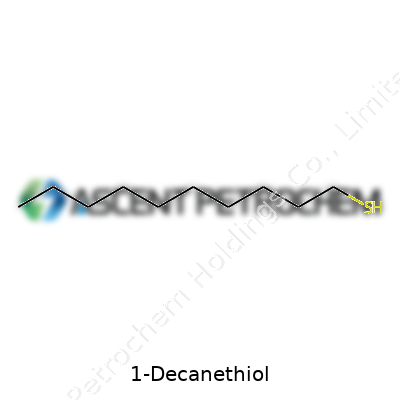
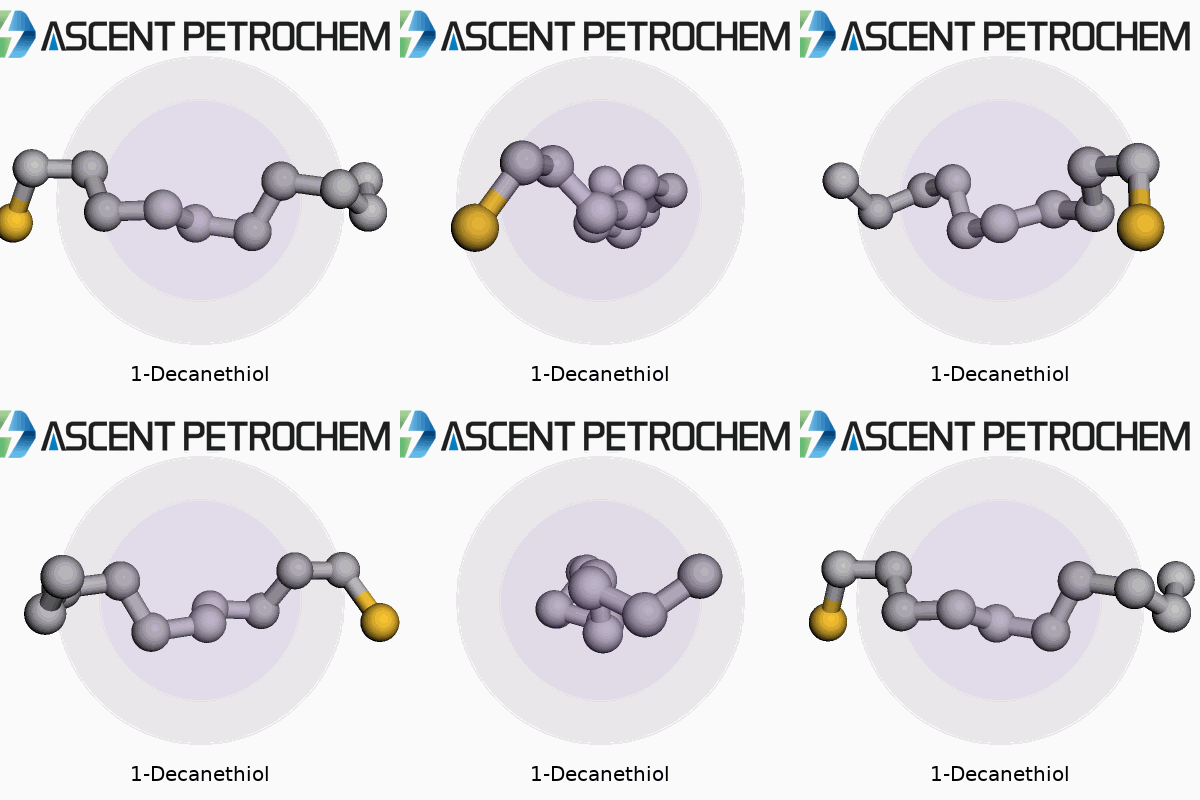
1-Decanethiol stands as one of those chemicals that turns up in a wide range of labs yet flies under the radar outside chemistry circles. Its formula, C10H22S, reveals its makeup: ten carbon atoms, twenty-two hydrogens, and a sulfur atom. The structure looks like a simple chain—think of it as a long piece of spaghetti with a -SH group at the end. That -SH (thiol) group makes all the difference in its reactivity. While it might just look like a regular long-chain hydrocarbon at first glance, swapping that last hydrogen of a decane molecule with the thiol group shifts its behavior dramatically. The straight-chain layout often gives it a strong, sometimes offensive odor. Anyone who’s handled thiols in the lab knows the smell lingers long after the glassware’s been scrubbed.
Why Structure Tells the Story
Structure shapes what a molecule does. For 1-decanethiol, the straight chain confers certain physical characteristics. Its melting point comes in surprisingly low compared to similar-sized alcohols or acids. This means it stays liquid at room temperature. That -SH group at the terminal position changes how it reacts with metals, creating strong bonds with surfaces like gold. I remember helping a fellow researcher prepare self-assembled monolayers—putting 1-decanethiol on a gold surface forms a dense, ordered layer. Surface chemists use this property to develop everything from corrosion-resistant parts to clever electronic sensors that can spot specific molecules present in samples.
Beyond the Lab: Why 1-Decanethiol Gets Attention
Plenty of industrial sectors rely on molecules with similar structures. Lubricant makers look for ingredients that limit friction and last through tough working conditions. The sulfur presence in 1-decanethiol gives it a unique touch; it acts as a surface modifier or even as a vulcanization agent in certain plastic and rubber applications. It’s true that not everyone thrills at the thought of dealing with organosulfur chemistry, but in the right hands, this molecule makes things work smoother or adds critical selectivity to coatings.
Health, Safety, and Responsible Chemistry
The strong odor points to another side: exposure should be managed with care. Inhalation irritates airways and, given repeated exposure, skin and eyes can suffer. My old university lab made safety briefings about thiols mandatory after someone mishandled a vial and cleared out a wing—few other chemicals get everyone’s attention so fast. Regulatory guidance stresses air filtration, use of gloves, and safe storage to avoid accidental release.
Thinking Ahead: Smarter Use for a Useful Molecule
Companies have begun paying more attention to lifecycle studies. Waste from thiol chemistry can persist when released, so process engineers now work on neutralization methods before disposal or recycling efforts that reclaim useful material. Green chemistry pushes for alternatives, but so far, the specific surface interactions—those monolayers I helped assemble—often mean researchers return to 1-decanethiol for its effectiveness.
Real progress comes from balancing its clear benefits against environmental and health demands. Routine exposure must stay minimal. Evolving standards ensure labs and industries consider both what makes this chain-and-sulfur combo so useful, and what must happen once it’s no longer needed. Even something as simple as a -SH group on a carbon chain deserves that level of respect and attention. Facts and careful practice keep it valuable rather than hazardous.
Why Storage Really Matters
Nobody who’s worked with 1-Decanethiol ever forgets its smell. That powerful, persistent odor turns lab coats into a warning sign, letting everyone know when something’s not right. Odor aside, this chemical packs more risk than just a bad scent. Liquids like this don’t play nice with oxygen, heat, or sunlight—they play nice with cool, dry, stable conditions where the only thing changing is the calendar.
Nailing Down the Right Storage Space
Every bottle with a hazmat label deserves respect, but 1-Decanethiol asks for it specifically. Over the years, keeping it away from oxidizing agents has always been a non-negotiable in labs I’ve worked in. I’ve seen shelves ruined and casual corners become accident sites because someone stashed a reactive bottle near bleach or peroxides. Flammable cabinets save more than just insurance headaches. These safety cabinets stop a spark from joining up with vapor, limiting injuries and the losses that follow.
Air-tight containers win out every time. The fewer chances for oxygen to sneak in, the smaller the odds of pressure building up or the chemical reacting. I’ve learned from old-timers that glass bottles with solid, fitted caps beat unlabelled squeeze bottles hands down. For added measure, labeling isn’t just a regulation—colleagues rely on it. Even down to the date, keeping those bottles marked cuts down on confusion and stops someone from reaching for a degraded or leaking bottle.
Keeping Conditions Consistent
Touches of humidity and swings in room temperature threaten more than just chemical shelf life—they risk everyone in the area. In warm labs without climate controls, vapors from volatile liquids fill the air with flammable gas. That makes high shelves in sunny storerooms a poor choice. Placement matters as much as the kind of shelf. Heavy containers go low to stop falls; any spill kit stays quick to reach. In some of the safer workplaces, chemical fridges keep hazardous inventory cool, separate, and out of reach for non-trained staff.
Protocols and People: Working Together
Real safety depends less on written rules than on the habits of people who share space. Every team I’ve worked with who handled 1-Decanethiol checked bottle seals and reviewed labels before opening cabinets. Regular inspections matter—most leaks come from tiny faults in a cap or a slow reaction with old plastic. Peer checks for storage dates, clarity, and integrity pick up oversights that even organized people miss late in the day.
Spill response supplies need to wait just steps away from where risks begin; I keep clay absorbents, towels, and personal protective gear at arm’s reach. A seasoned mentor once said, if you don’t have goggles on before touching the cabinet handle, then you’re asking for trouble. This advice holds: safety is a habit, not a box to check.
Better Habits, Fewer Surprises
If a chemical’s scent turns heads, it’s not something to treat casually. Flammable liquids like 1-Decanethiol demand routines—right containers, cool storage, clear labels, and regular checks. No shortcuts. Training the whole team sets up safer days, fewer surprises, and no stories that start with “You won’t believe what spilled last week.” That’s just good lab practice—rooted in experience, science, and a respect for the unpredictability of chemistry.
A Look at Its Makeup
Pulling apart 1-Decanethiol, you find a chain of ten carbon atoms with a single sulfur-hydrogen group tacked on the end. It’s a clear or pale yellow liquid with that unmistakable sulfur stink—you can’t miss it, even with the bottle tightly capped. This sulfur group, hanging off one end, shapes how it mixes, smells, and reacts with other stuff. The long carbon chain sets it apart from many other thiols found in everyday labs or chemical plants.
Physical Traits That Matter in Real Life
Handling 1-Decanethiol, you notice it’s runnier than syrup but thicker than water, pouring at room temperature with ease. It boils just over 230 degrees Celsius—fairly high, so it doesn’t vanish into the air too fast, but if you spill some, the odor lingers for hours. Its low water solubility leads it to bead up or float when mixed. That means any release into a drain or water system winds up on the surface, carrying an odor that easily travels. You get a flash point around 96 degrees Celsius, so it’s not the sort of thing anyone wants near sparks or open flames.
Chemical Behavior and Why It Matters
Sulfur chemists pay close attention to how 1-Decanethiol reacts. The thiol group on the end makes it a good nucleophile, grabbing onto metals or reacting with certain organic chemicals. That brings utility to metal processing. In my own background, treating metal surfaces or making specialized coatings, it’s easy to see how 1-Decanethiol acts as a strong anchor, forming bonds with gold or copper surfaces—applications you see in electronics for mounting circuits or even making quick connections at the molecular level.
Exposure to oxygen changes things; the thiol group grabs oxygen and might form disulfides, particularly in open-air storage. I’ve seen containers go from a sharp thiol reek to something more muted and less recognizable, signaling chemical change from exposure. Chemists working with this compound always want tight lids, inert gas, and storage away from UV light or reactive metals. Regular folks rarely see it, but keeping these controls matters, because safety demands attention to both fumes and chemical instability.
Uses and Real-World Impact
Manufacturers use 1-Decanethiol in producing lubricants, making flotation agents for mineral extraction, and even as a chain transfer agent in polymer chemistry (helping control the structure of plastics). In every case, handling and odor present real headaches. Even tiny spills produce a lasting, skunky aroma indoors. Emergency crews, lab workers, and waste specialists learn quickly that standard ventilation and gloves don’t always stop the smell or possible exposure. Good ventilation and double-checking containers stay sealed go a long way toward minimizing headaches, both literally and figuratively.
Challenges and Paths Forward
The biggest challenge: that brutal odor. In the past, I’ve had entire floors clear out after a small bottle broke. Newer engineering controls involve closed transfer systems and chemical neutralizers, but at the end of the day, solid planning and training work better than fancy equipment. Disposal also needs care—never pour down the drain or toss with general waste, since water treatment systems and neighbors notice quickly. Finding greener alternatives isn’t simple. The sulfur atom gives 1-Decanethiol its power, but also its environmental footprint.
You get a sense for its punch quickly, both in the lab and when talking to safety officers at big plants. For those working with it, respect for both chemistry and safety culture goes a long way—no substitute for good habits and practical know-how.
| Names | |
| Preferred IUPAC name | decan-1-thiol |
| Other names |
Decyl mercaptan
1-Mercaptodecane n-Decyl mercaptan |
| Pronunciation | /ˈwʌn.dɪˈkeɪnθaɪ.ɒl/ |
| Identifiers | |
| CAS Number | 143-10-2 |
| Beilstein Reference | 1209244 |
| ChEBI | CHEBI:39490 |
| ChEMBL | CHEMBL170222 |
| ChemSpider | 5279 |
| DrugBank | DB11267 |
| ECHA InfoCard | ECHA InfoCard: 100.003.444 |
| EC Number | 203-983-6 |
| Gmelin Reference | 84193 |
| KEGG | C02574 |
| MeSH | D003669 |
| PubChem CID | 8124 |
| RTECS number | UC7875000 |
| UNII | 5K39867M1S |
| UN number | UN1147 |
| Properties | |
| Chemical formula | C10H22S |
| Molar mass | 178.37 g/mol |
| Appearance | Colorless to pale yellow liquid |
| Odor | Unpleasant, garlic-like |
| Density | 0.845 g/mL at 25 °C (lit.) |
| Solubility in water | Insoluble |
| log P | 4.82 |
| Vapor pressure | 0.019 mmHg (25 °C) |
| Acidity (pKa) | 10.6 |
| Basicity (pKb) | pKb = 3.56 |
| Magnetic susceptibility (χ) | -64.0·10⁻⁶ cm³/mol |
| Refractive index (nD) | nD 1.445 |
| Viscosity | 2.293 mPa·s (20 °C) |
| Dipole moment | 1.41 D |
| Thermochemistry | |
| Std molar entropy (S⦵298) | 395.3 J·mol⁻¹·K⁻¹ |
| Std enthalpy of formation (ΔfH⦵298) | -222.3 kJ/mol |
| Std enthalpy of combustion (ΔcH⦵298) | -6700.7 kJ/mol |
| Hazards | |
| GHS labelling | GHS02, GHS05, GHS06, GHS08 |
| Pictograms | GHS06,GHS05,GHS07 |
| Signal word | Danger |
| Hazard statements | H226, H301, H311, H314, H331, H411 |
| Precautionary statements | P210, P261, P273, P280, P302+P352, P304+P340, P305+P351+P338, P310, P312, P362+P364, P370+P378, P403+P233, P501 |
| NFPA 704 (fire diamond) | 2-3-0-W |
| Flash point | 93 °C |
| Autoignition temperature | 204 °C |
| Explosive limits | Explosive limits: 0.9–6.5% |
| Lethal dose or concentration | LD50 oral rat 2080 mg/kg |
| LD50 (median dose) | LD50: 468 mg/kg (rat, oral) |
| NIOSH | KY9275000 |
| PEL (Permissible) | PEL (Permissible Exposure Limit) for 1-Decanethiol is 1 ppm (skin) |
| REL (Recommended) | 0.03 ppm |
| IDLH (Immediate danger) | 150 ppm |
| Related compounds | |
| Related compounds |
1-Nonanethiol
1-Undecanethiol Decane 1-Decanol Thioanisole |


